|



OAKLAND
TRIBUNE
January
29, 2003
by
Jolene Thym
 
Pro
organizer can clean up even the most cluttered kitchen
I
like tidy. I want tidy. I need everything to be
put away, out of sight all day, every day. It's OK to
use a pan or a dish or a cup, but please put it back ASAP.
Don't even think about leaving stacks of stuff on my counters.
And don't talk to me about convenience. It never hurt
anyone to bend down to get something. Or to reach.
It won't kill you, I promise.
Knowing
all of this, you can understand why the last thing I thought
I could possibly need help with is organizing my kitchen.
When my editor presented the idea to me over the phone, I
rolled my eyes, threw my hands up in the air -- and agreed
to invite a stranger into my kitchen.
I
had to admit that every drawer is full. Plastic containers
tumble out of the cabinet at will. Pans and dishes are
arranged in perfect puzzle order -- one dish out of place
and there's no hope. I realize there is a slight space
crunch, but I have the perfect solution: We need to
cut a hole in the ceiling to increase vertical storage.
It's the obvious answer. It's what I want to do.
I don't need an organizer. I need a hole in the ceiling.
Meg
Connell, a professional organizer from Oakland, arrives at
our miniature mansion with a smile, ready to help. She
heaps on the compliments about the colors and décor
of my kitchen as I expose my inner self, revealing the contents
of more than a dozen cupboards.
Each
time I open a door, she has questions. I have answers.
Folders filled with things like bank papers, school papers
and dentists bills in the cupboard above the microwave are
carefully labeled with their contents. Why would she
ask what they are? She points to the glue and glitter.
What can I say? I love crafts.
She
opens what she calls the pantry and looks askance at my linens.
Yes, linens. She points to the giant bin of barrettes
and hair scrunchies and curlers. Three daughters, need
I say more?
Soon,
the questions stop. She quietly and politely continues
to explore, seemingly searching for something. Finally,
she asks.
"What
do you eat?" Ah, yes, the food. With trepidation
and shame, I lead her to our sloppy laundry room, home to
rice, potatoes, soda pop, canned goods, vinegars, syrup, and
enough snack foods to ward off weight loss for months.
Connell
nods in understanding as she surveys the stash -- and thankfully
does not look behind the laundry bin and under the grimy sink
to see our supply of sauces, syrups and juices that keep company
with carpet cleaner, wax and bleach.
She
seems so content with her discovery that I don't tell her
about the chocolate and tuna in my closet and the wine and
soda and cookies in my coat closet.
We
return to the kitchen and Connell pulls a paper out of her
briefcase. As she begins to write, she asks brightly,
"Wouldn't it be nice to have the food in the kitchen?"
Precisely
why this novel thought did not occur to me after 17 years
of living in this house, I am not sure. I try to explain
the why behind our odd food storage system. But there's
nowhere to put all of this," I whine, knowing she
will understand our crowded reality.
Again,
Connell smiles. She really is very nice. And diplomatic.
"The idea is to get things into the room that they are
used," she quips. Books belong on a bookshelf.
Papers belong in a file cabinet, tools in the garage, candles
in the linen closet.
Once
each item is in the room where it belongs, you make a space
for it. Connell has another question. "Tell
me: What's working for you in the kitchen and what isn't?"
I
told her that my husband hates diving into the cupboard under
the counter for plastic containers, and that I was frustrated
with the ultra-deep cabinets and the main utility drawer located
right under the cutting board.
Connell
isn't one for wasting time.
She
started asking how often I used various items, then began
switching drawer contents, moving the potholders up a drawer,
favorite utensils down a drawer, and rarely used items across
the kitchen. She then suggested swapping the contents
of entire cupboards. The often-used plastic containers,
she says, can go up into the convenient cabinet above the
counter. Now that the kids are grown, the platters and
vases that were stored there can be put in a lower cabinet.
"You
have to really ask yourself how often you use something,"
she says. "If it's everyday, then it can be in
a prime area." An item that is used once a month,
once a year, or even less needs to be stored in the most remote
parts of a cupboard.
"What
you need to be concerned with is utilizing the space that
is easy to reach."
Besides
devoting half of the space of a prime cabinet to important
papers, the other huge problem with my kitchen, Connell says,
is the utter waste of space in the main pantry cabinet.
"This
is really valuable space. You need to make it work for
you."
It's
OK to use cupboards and drawers as-is, she says, but real
organization requires a few tools.
"You
can clean a drawer or a cupboard like this out over and over,"
she says, 'but it still gets messy because it's a design problem."
No kidding.
Drawers
need to be divided. Doors and shelves sometimes need
platforms or racks. Really deep cupboards and low cupboards
become much more usable with roll-out shelving.
|
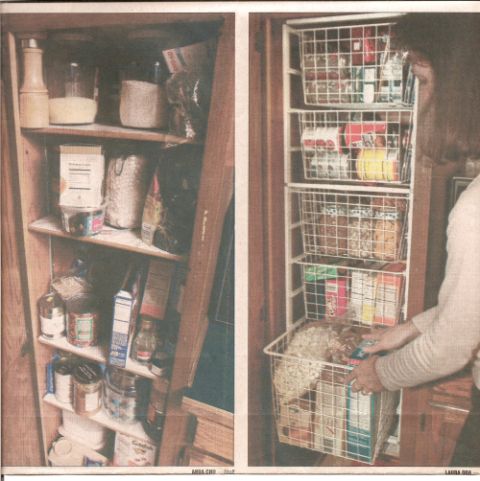
Pantry Before Pantry After |
Exactly
what someone need to get organized and stay organized, Connell
points out, can be fund at stores like Target, Wal-Mart and
Home Depot. But people who need even more remedial help
or examples should probably window-shop at specialty stores
such as Organize It, Organized Living, Hold Everything and
the oldest in the group, The Container Store.
One
look inside the store and you know that these people exist
to be organized. They want to be organized. They
want you to be organized. They want the entire world
to be organized.
"Our
lives have become so busy these days that time is our most
precious commodity," says Mona Williams, senior merchandise
director for The Container Store chain, based in Texas.
"We are desperate for the kind of organization that gives
us a little more time and helps us to achieve a sense of control
over our lives.
"Also,
we've seen a jump in sales since 9/11. People are staying
closer to home and are spending a lot more time in their kitchens."
The reason why kitchens often get so out of control, she says,
is that the function of the kitchen is continually changing.
"The
kitchen isn't just for cooking or eating in any more.
It seems to be where we congregate, which means a lot goes
on there. We see kitchens as the communication center
for the family."
I
tell Williams about my most problematic pantry cabinet.
It's this really deep cabinet, more like a black hole, where
things just disappear. In the cabinet is a snack shelf,
a cans shelf (unbeknownst to half of the family,) a breakfast
shelf and two bulk foods shelves.
The
bulk foods aren't a problem, but on the other shelves, there
is so much space that every time someone opens a package of
crackers or cookies and puts it away on whatever shelf they
have personally selected as the snack shelf for the day, it
falls into the the black hole, never to be seen or
tasted again.
The
entire cupboard, we suspect, is the place where all uneaten
snacks go to dry out, shrivel up and turn rancid.
The
fix for such a cabinet as this, Williams says, was invented
decades ago. It's called an elfa drawer unit, a plastic
coated metal frame with wire drawers that fits into the cabinet
space.
"With
the roll-outs, you can see everything you have at a glance.
Things don't get lost," Williams says. "The
key is not to waste space (anywhere in your kitchen).
You want to start from the bottom up or the top down and organize
every inch of your kitchen."
For
the most part, Connell's solution to my kitchen troubles was
a bit like musical cabinets, a job of relocating.
"You
have all your systems in place," she tells me "they
just need tweaking."
For
example, she applauds the fact that I have serving platters
and bowls all stored together. But they are high and
difficult, if not dangerous, to reach. Likewise, she
likes my bulk foods storage system in glass jars. But
they are stored in prime areas, rather than in the remote
cabinets that are for "occasional-use" items.
Connell
also confirms my suspicion that this place is just plain full.
"You seem to have used nearly every available space.
You are bulging at the seams."
That
said, she goes on to share an observation that will delight
my husband: "One of your problems seems to be that
you want so much for things to look nice that you overlook
functionality."
To
that, I think "And your point being?" but I smile
and nod, knowing that little quirk about me will never change.
In the two hours that Connell and I have known each other,
it's clear that she understands that too.
"You
might check into some of the new storage ideas. Some
are made of wood. Some are really good looking,"
she offers. She also suggests that an antique cabinet
that matches the other furniture in the house might be converted
into a home business center, and that I might be able to swap
one of my small, not-so-pretty china cabinets for a hutch
with drawers, so I can store my linens there instead of the
pantry.
"You
can give that one to your daughter when she moves out."
For
others in my storage predicament, Connell shares the comforting
fact that I am "normal."
"People
who have established households tend to have not only everything
they need, but a whole lot more. Many people in your
situation just start stacking and piling things everywhere."
In
her years as an organizer, Connell says she has encountered
all kinds of people who like to keep their homes all different
ways. To those who like organization but are struggling,
she offers this advice:
"The
solution to every storage problem is to define a space for
it and to create a system to store it.
"My
goal when I come into a person's home is not to change them
or to get them to throw stuff out, but to try to help them
organize what they have."
When
I tell her I had an extra waffle iron, a toaster I never use
and too many cooking utensils, she suggests I remove those
items from the precious kitchen space, and put them away for
my children, who will be starting their own homes soon.
She
notes my rather large library of cookbooks stored in and around
the kitchen. "You might want to sort through them
and make sure that you really want all of them but you really
just need a place for them to be," she says. "You
need a bookcase." She pauses. "You need
two."
Three
hours after she arrived, Connell hands me a list of things
to do to make my life more organized, things that I am not
at all convinced I need to do. After all, I didn't really
need an organizer.
But
after I said good bye, I had to finish organizing that drawer
she started to organize. Then it just made sense to
follow her suggestion of moving those towels and washcloths
to the drawer across the kitchen that was filled mostly with
junk.
But,
of course, you can't throw out the contents of one drawer
without going through the one right next to it.
"Mom,
what's for dinner?" my 10-year-old asks four hours later.
I barely hear the question, as I keep thinking "Food
in the kitchen, she says the food should be in the
kitchen."
I
dump the contents of a file cabinet -- filled with kid projects
and mementos -- and move all of the family papers out of the
kitchen, into the file cabinet. I retrieve food and
more food from all over the house to put in the now-empty
space in the kitchen cabinet.
'Uh,
dinner?" still no answer. By midnight, I'm too
tired to think. The next morning, pleased to wake up
to some food in the kitchen, I mull over Connell's idea to
move the plastic containers into the platters cupboard.
In the middle of cleaning up breakfast, I shift into high
gear.
Everything
out, everything in. Houston, there's a problem.
The platters don't fit in the plastic cupboard. Undaunted,
I sit and ponder until I hit upon a solution.
Plastics
to the platter cupboard, platters to the baking cupboard,
and baking dishes to the plastics cupboard. Hours pass.
Bags of unwanted items are carted out to the trash.
The
sun has gone down. The kitchen is ergonomically organized,
with food in its cupboards. Maybe I'll look over Connell's
list again tomorrow. After all, she was really nice.
RULES
OF THUMB FOR GETTING ORGANIZED
Meg
Connell, a professional organizer from Oakland offers these
suggestions to people who would like to add some organization
to their kitchen or pantry:
Survey
every square inch of space in your kitchen and decide which
areas aren't working for you. Start there.
Make
sure that all spaces within easy reach are home to items that
are used nearly every day.
Space
that is too high to reach can be home to items that are used
less often.
Modify
cabinets with pull-out shelves or lazy Susans so that you
don't have to pull entire contents out to get to a single
pan. It will save lots of frustration later.
Try
not to store pans or other cooking utensils more than two
deep. Having to dig to get to what you want promotes
disorganization and frustration.
When
areas continually become disorganized, it is often because
of a design problem. Is the drawer or cabinet too shallow,
too deep or too narrow for what you are trying to store?
Try moving those items to drawers or cabinets better suited
for them, or modify the drawers or cabinets with organizing
inserts to make them more useful.
In
organizing drawers, try to always keep like items together
in a separate section. Most used items should be at
the front of the drawer. Claim space at the back of
a drawer for seasonal or infrequently used items.
In
organizing foods, put like items together whenever possible.
Keep
small amounts of staples in prime, easy-to-reach space.
Store backup supplies in high or low cabinets.
If
you haven't used an item for an entire year, consider throwing
it out.
When
trying to organize, think vertical. Try hanging lids,
pans or other items on the wall or from a rack attached to
the ceiling.
When
analyzing space, consider negative space (ie: air.)
You can use space more efficiently by adding or moving shelves
or adding cabinet accessories.
Don't
overlook the insides of cabinet doors as storage areas.
They are great spaces for racks of all shapes and sizes.
Keep
in mind that for every minute you spend organizing, you save
six minutes later on.
Be
sure to clean out your prime, ergonomic areas every few months
so that they are always in top working order. Other
areas can be cleaned out less often, but don't forget to clean
out and throw things away as often as you can.
TOP
|